

Loading content…
Loading content…
BULGARIA AS IT IS!
Enyovden falls on 24 June. Folk traditions connect it with gathering herbs before sunrise, making wreaths and beliefs about the sun and water.
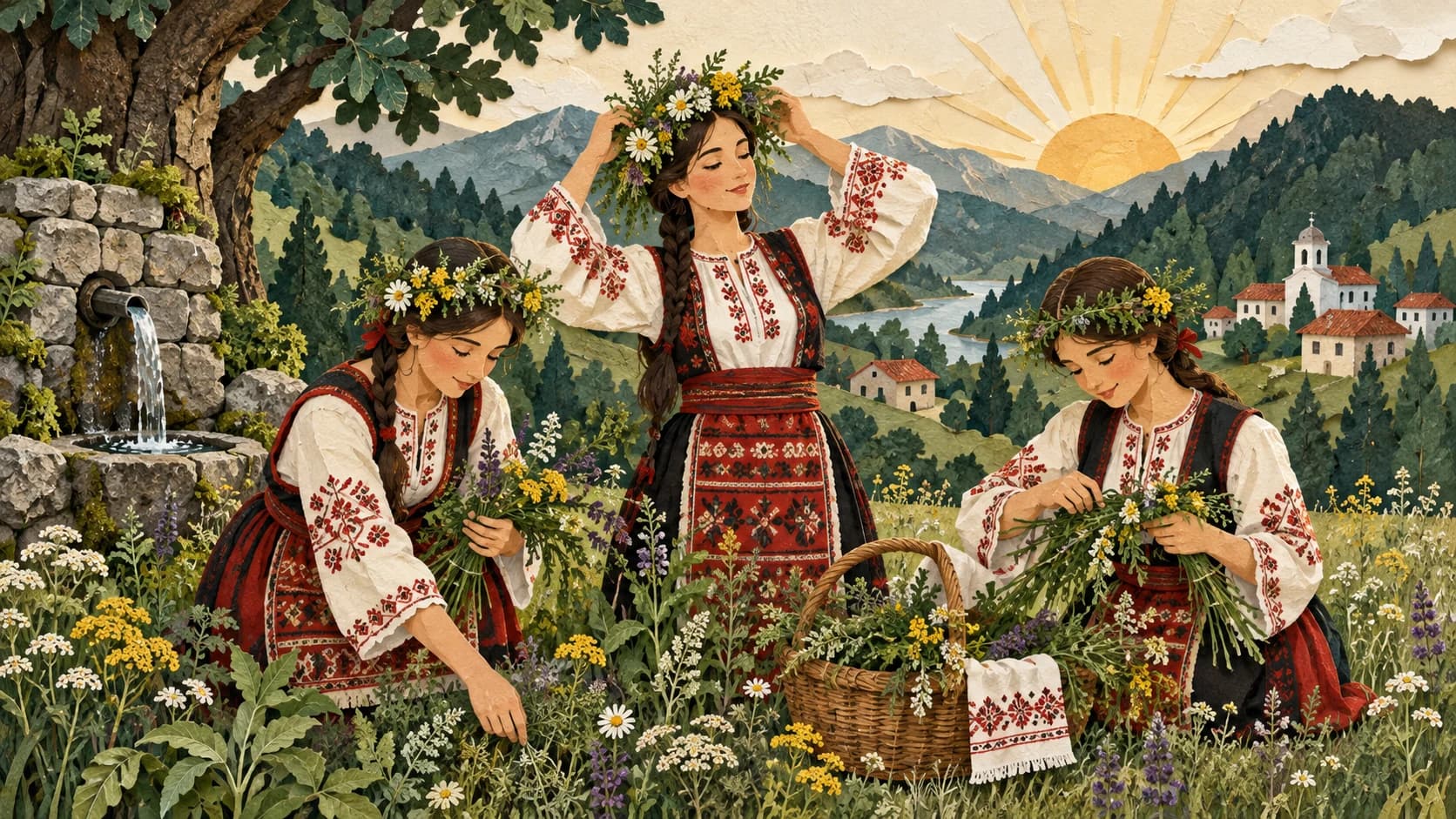
On 24 June the Church celebrates the birth of St John the Baptist. The folk celebration also concerns the sun, water and plants at the beginning of summer. Stories say the sun dances at dawn and herbs have special power. These beliefs explain the season; they are not proof of medicinal properties.
Enyovden is close to the summer solstice, but the two dates are not identical. Accounts of the dancing sun, dew and powerful herbs belong to festive ideas about nature. Beliefs must be distinguished from medical advice: plants have real properties, but a festive hour alone does not establish a healing effect.
Herbs are gathered early, often before sunrise. They are made into bunches and a large wreath. In some places people pass through it for health, while girls take part in separate rites and songs. Plant species and practices differ by region. Surviving festive costumes also record these local variants.
Some regions make a wreath of “77 herbs and a half”: a folk image for many illnesses and remedies, not a botanical list valid everywhere. Museum specialists in Burgas gather plants before dawn and invite people to pass beneath a large wreath. Girls’ songs and rites such as Enyova bulya are known in certain regions. The celebration is more than a wreath, but not every community performs all these practices.
Community cultural centres, museums and local groups recreate Enyovden practices. The occasion may be a shared herb walk, a song or a procession. Such encounters preserve knowledge of local forms without presenting one reenactment as the only ancient custom.
The Burgas Ethnographic Museum’s 2024 reenactment is an example of passing on knowledge today: curators explain why people gathered herbs and the meanings they gave them. The event does not prove that every old variant looked exactly like this. It can preserve names, songs and skills and encourage local accounts to be recorded before they disappear.
Historical information, local examples and current practices were checked against these publications.
Created with ImageGen for СБОРЪ.БГ. An artistic interpretation of the custom, rather than a documentary photograph.
Vassia Atanassova – Spiritia · Бургаски етнографски музей, Бургас · 2008 · CC BY-SA 3.0 · Original