

Loading content…
Loading content…
BULGARIA AS IT IS!
Lazaruvane is a spring custom on Lazarus Saturday, the day before Palm Sunday. Groups of girls visit homes with songs and good wishes.
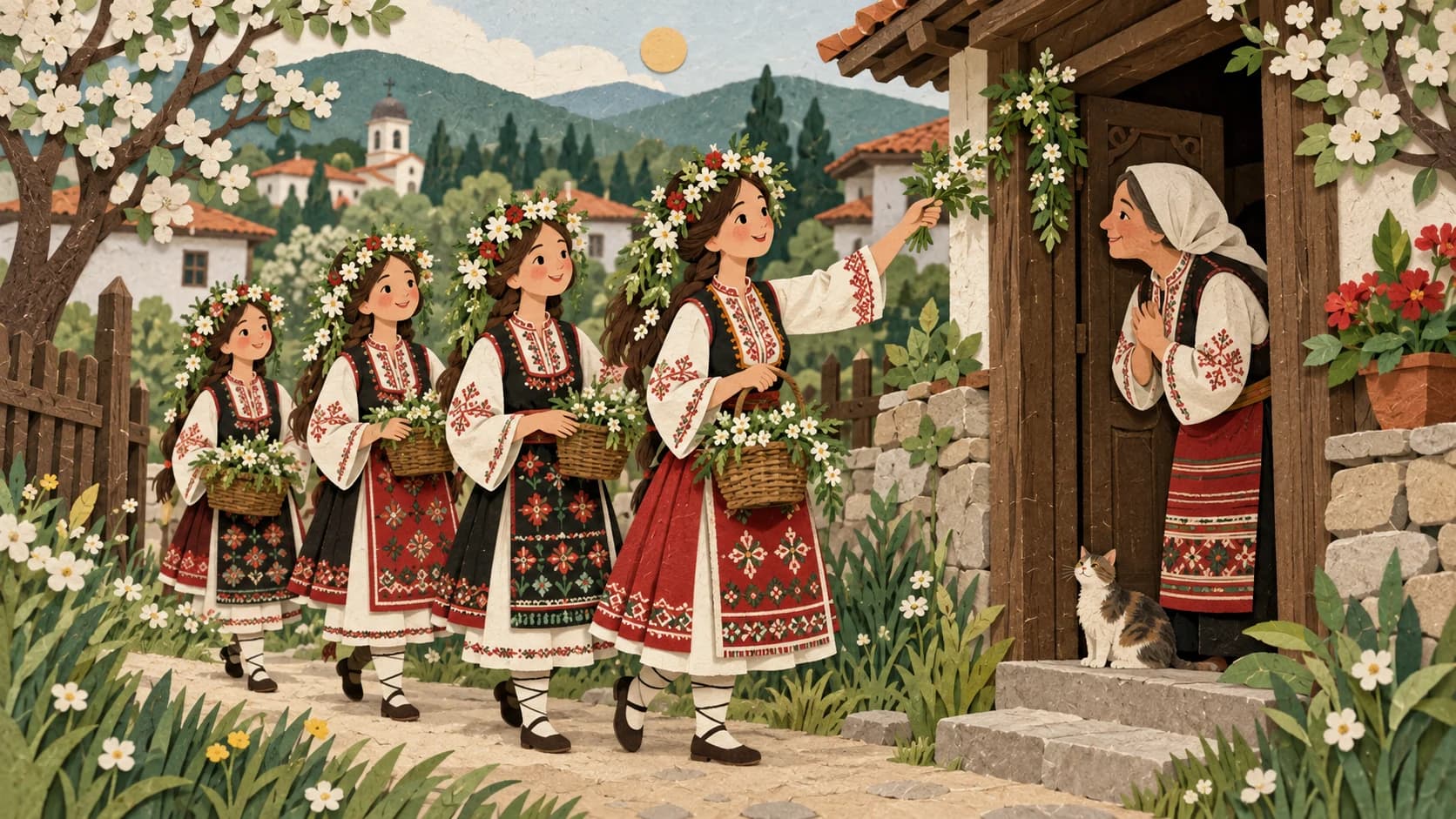
Lazaruvane takes place on Lazarus Saturday, before Palm Sunday. It bears the Christian feast’s name, but its folk form carries spring wishes for life, health and fertility. Its precise beginning is unknown. Many local accounts describe participation as an important step towards a girl’s adult place in the community.
Lazarus Saturday is fixed in relation to Easter, so its calendar date changes. The girls’ rounds give them a visible place in the community: they prepare together, dress festively and bring wishes from house to house. Ethnographic accounts recognise its meaning for growing up, but it should not be described as an identical, compulsory initiation ritual in every village. Roles and songs vary locally.
The lazarki dress festively, form a group and visit houses. Songs are chosen to suit the household and its members. Hosts welcome them with gifts, often eggs for the coming Easter. Dances, wreaths and roles within the group have local variants.
In the Tsaratsovo example described by UNESCO, the girls first dance in the square and then visit homes. Their leader is called the kuma, and the song is chosen for someone in the house, such as a child or a young man. The hostess gives eggs and other gifts. This village shows how blessing, dance and hospitality work; it is not a standard against which other local variants should be corrected.
Lazaruvane continues where girls learn it from elders, a community cultural centre or a local group. UNESCO describes Tsaratsovo near Plovdiv, but this example is not compulsory for all Bulgaria. Differences between places are themselves signs of a living tradition.
The community cultural centre in Tsaratsovo presents lazaruvane as a living local practice. UNESCO’s page describes this activity for an anniversary of the Convention, rather than an inscription of lazaruvane on the Representative List. The distinction matters: recognising cultural centres’ role in safeguarding heritage does not make every custom a separate UNESCO element. Continuity lies in learning songs and making the rounds together.
Historical information, local examples and current practices were checked against these publications.
Created with ImageGen for СБОРЪ.БГ. An artistic interpretation of the custom, rather than a documentary photograph.
Biser Todorov · България; точното място не е посочено · 2016 · CC BY-SA 4.0 · Original