Loading content…
Loading content…
BULGARIA AS IT IS!
Easter celebrates the Resurrection of Jesus Christ. Bulgarian festive customs include dyeing eggs, baking bread and visiting family.
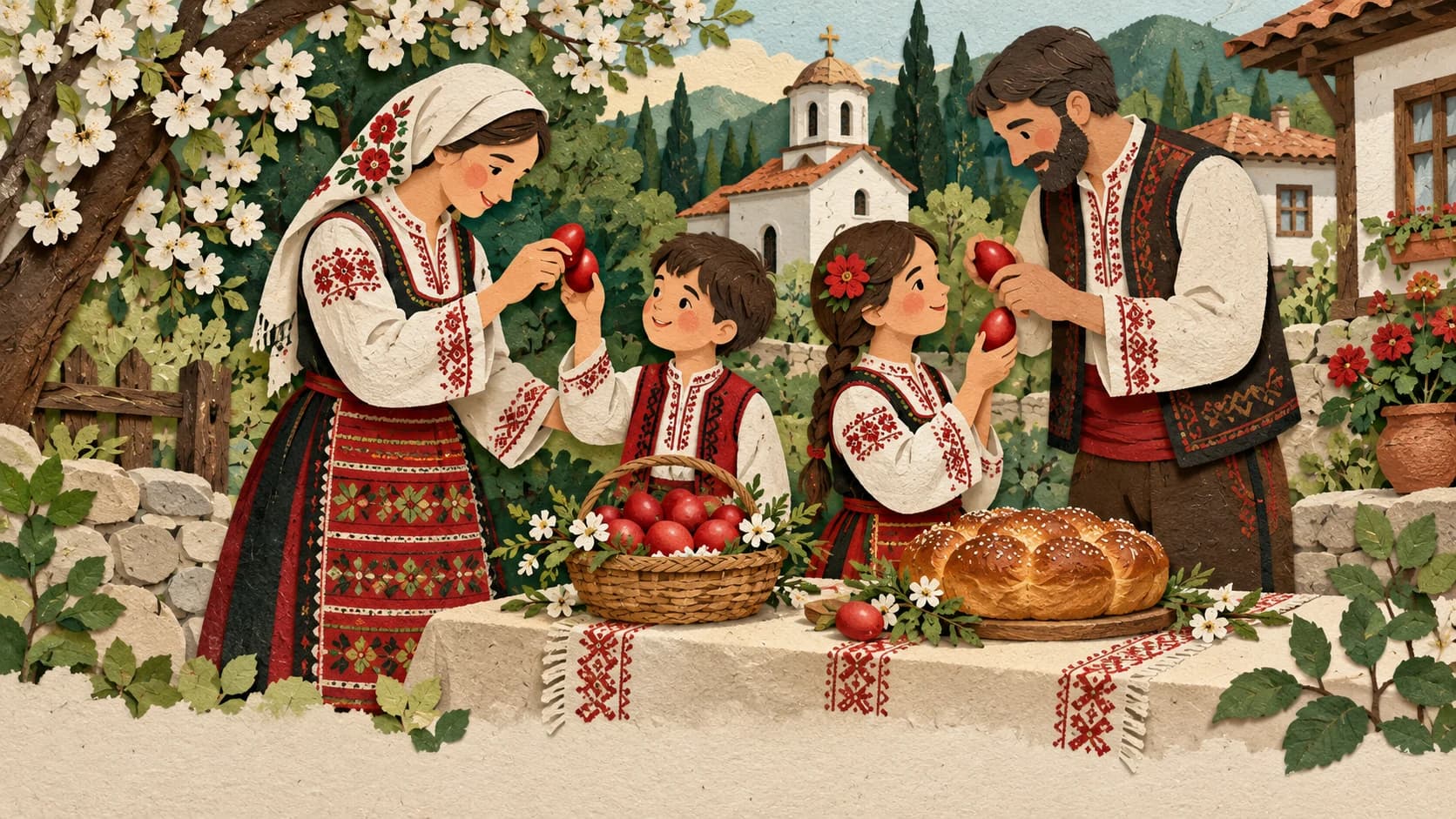
Christian belief in the Resurrection of Jesus Christ lies at the heart of Easter. Bulgarian household customs involving eggs, bread and family visits developed around the church feast. Regional variants do not descend from one single recipe or legend.
Easter is above all the Christian feast of the Resurrection. Household practices follow the church calendar but vary locally: dyeing, baking and visiting do not take the same form everywhere. Older ritual meanings of eggs or bread may be discussed, but resemblance to an ancient symbol cannot establish the origin of every present-day practice. Written and ethnographic records describe the customs themselves more reliably.
Dyeing begins before Easter Sunday. The first egg is usually red; some families use it to make a mark on children’s foreheads. At Easter, eggs are given as gifts and tapped against those of relatives and guests. Colours and techniques have changed, but the red egg remains one of the celebration’s most recognisable symbols.
Bulgarian National Radio describes the first red egg as special: mothers touch children’s faces with it to wish them health. Depending on the family, eggs are dyed on Holy Thursday or Saturday, then given as gifts and tapped at the festive table. Dye, drawings and wax decorations reflect local taste and household skill. No single correct ancient model should erase this diversity.
Before kozunak became customary, different ritual breads were baked for Easter, often decorated with dyed eggs. Their names, shapes and decorations vary by region. An older ritual loaf and a modern kozunak may share the same table. Visiting parents, godparents and relatives remains important.
Easter ritual breads were gifts for relatives and godparents, often with eggs woven into them. Kozunak is now very popular, but does not represent every older form of festive bread. Baking and visiting keep the celebration a shared activity rather than simply table decoration. Museum presentations show regional differences in the bread’s shapes and names.
Historical information, local examples and current practices were checked against these publications.
Created with ImageGen for СБОРЪ.БГ. An artistic interpretation of the custom, rather than a documentary photograph.
Justine.toms · България, 43.154664° с. ш., 25.546172° и. д. · 2018 · CC BY-SA 4.0 · Original