

Loading content…
Loading content…
BULGARIA AS IT IS!
Nestinarstvo is a ritual from Strandzha associated with Saints Constantine and Helena. In Balgari, a procession with icons culminates in barefoot dancing on embers.
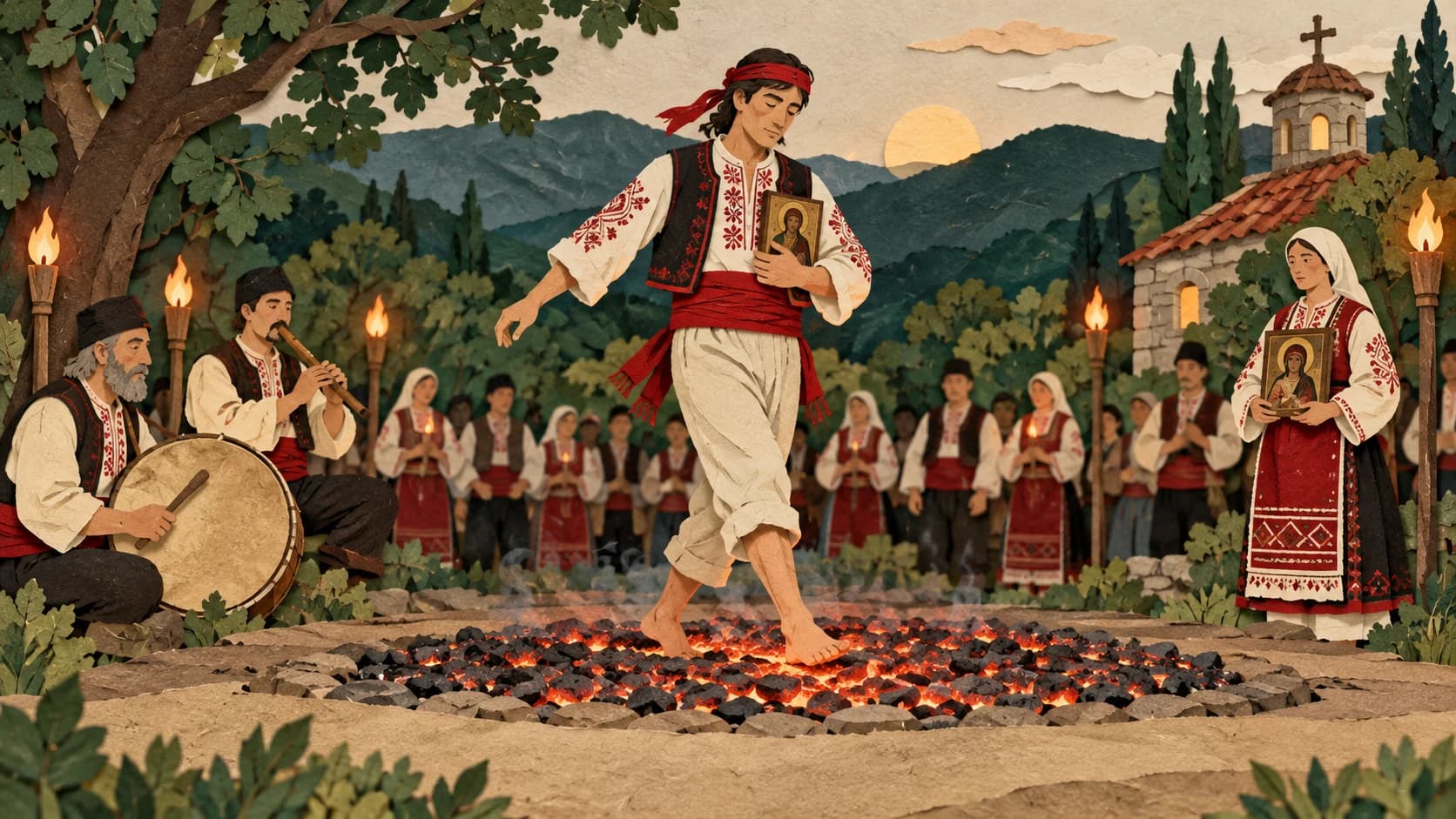
Nestinarstvo honours Saints Constantine and Helena in Strandzha. Barefoot dancing on embers is only part of the celebration: a procession with icons, music and shared preparations comes first. Petko Slaveykov published one of the earliest accounts in 1866. A connection with the cult of Dionysus has been proposed, but it is not a proven historical origin.
UNESCO describes nestinarstvo as the culmination of the panagyr honouring the two saints, rather than an isolated act of firewalking. The ritual brings together prayer, icons, a spring, a drum, a bagpipe and a shared meal. People associate it with the village’s wellbeing and fertility. These living meanings do not establish any particular ancient religion as its origin; historical layers must be distinguished from popular explanations.
In Balgari, the celebration takes place on 3 and 4 June. During the day, icons are carried to a sacred spring, accompanied by drum and bagpipe. In the evening, the fire is spread into embers and the nestinari enter carrying icons. Music, the procession and the community’s presence belong to the same event, rather than serving as scenery for a separate dance attraction.
The day follows its own sequence. The morning procession takes the icons outside Balgari to the sacred spring, where blessed water and candles are distributed. Only in the evening do people form a circle around the embers, which the dancers enter to the sound of the sacred drum. Showing only that last moment hides the relationship between the saints, the village and the participants: the heart of the community’s celebration.
The ritual was once known in other villages in the region. Today UNESCO associates the surviving practice with Balgari; it entered the Representative List in 2009. Stage performances can show the dance, but cannot replace the celebration passed between generations in the village.
UNESCO notes that the ritual once existed in dozens of Bulgarian and Greek villages in Strandzha and is now preserved in Balgari. This is a history of interruptions and transmission, rather than an unchanged form surviving from antiquity. Local practitioners decide how to prepare the celebration and who participates. Visitors encounter a tradition that exists beyond the stage and tourist interest.
Historical information, local examples and current practices were checked against these publications.
Created with ImageGen for СБОРЪ.БГ. An artistic interpretation of the custom, rather than a documentary photograph.
Apokalipto · село Българи, област Бургас · 2010 · CC BY-SA 4.0 · Original